
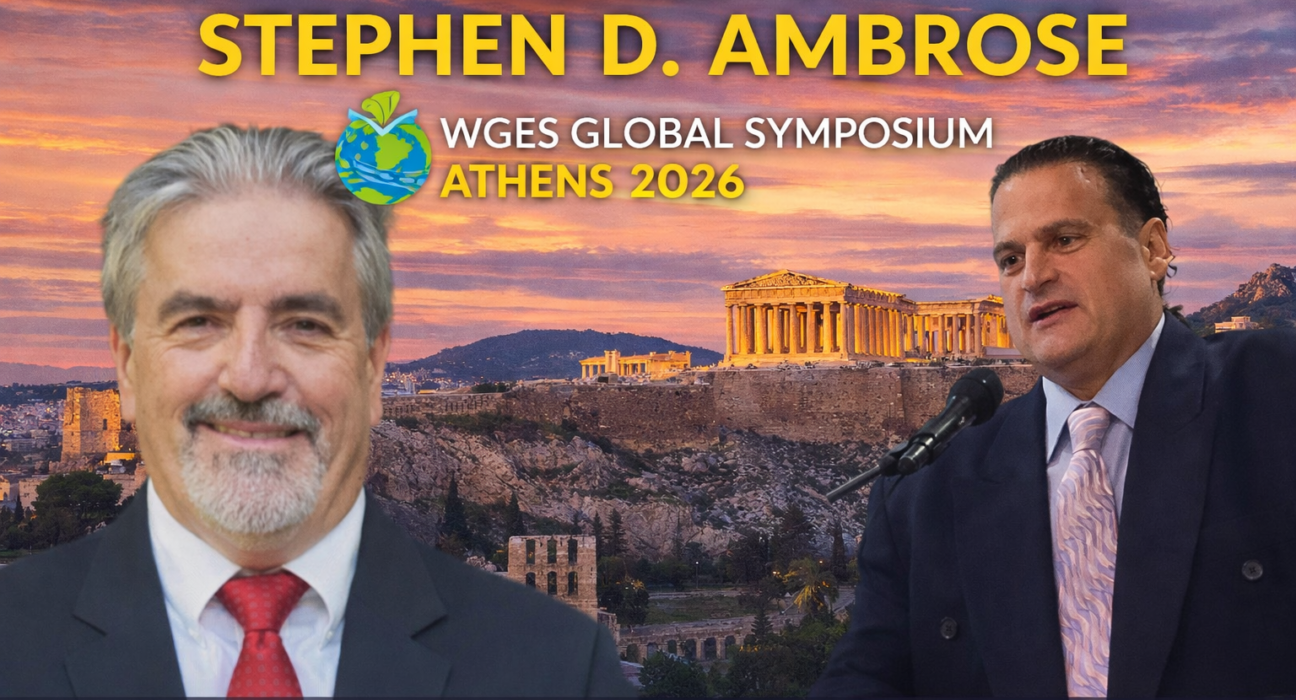
As global climate challenges intensify and the need for sustainable energy solutions becomes more urgent, the World Green Energy Symposium (WGES Global 2026) in Athens will bring together leading scientists, policymakers, and industry innovators from around the world.
Among the distinguished speakers is Mr. Stephen D. Ambrose, a renowned climate scientist with decades of experience in meteorology, Earth sciences, and environmental research. Throughout his distinguished career, he has served in key roles within major U.S. scientific institutions, including NOAA and NASA, contributing to the development of advanced climate monitoring systems, disaster response strategies, and satellite-based environmental observation technologies.
formerly with as Chief Climate Scientist at SAIC, Dr. Ambrose leads initiatives focused on climate data analysis, disaster resilience, and the development of science-based solutions that support governments, industries, and communities facing the impacts of climate change.
With a career spanning both the public and private sectors, Dr. Ambrose brings a unique perspective on how scientific innovation, technological advancement, and international cooperation can help address some of the most pressing environmental challenges of our time.
Ahead of his participation at the WGES Global Symposium in Athens (May 19–21, 2026), we spoke with Dr. Ambrose about the evolving science of climate monitoring, the role of satellite technology in disaster preparedness, and the future of global climate resilience.
DIMITRIOS KANNAVOS – Dr. Ambrose, after decades of experience in agencies such as NOAA and NASA, how would you describe the most critical changes in the way we understand and monitor the Earth’s climate today?
My experience at NOAA and NASA and I will include my industry experience with SAIC and others, over the years, saw a fast growth in research, science and applications, but we still have a long way to go. The most critical changes in the way we understand and monitor the Earth’s climate today is due to the growth of international cooperation and industry participation in developing, building and launching Earth observation platforms. Small satellites have become cost effective as well as a solution to saving the costs associated with building large satellite bus platforms.
DIMITRIOS KANNAVOS . Satellite technology has transformed environmental observation. How important are satellite systems in predicting and mitigating natural disasters?
Stephen D. Ambrose – Greece is the perfect platform at WGES 2026 to talk about the transformation satellite technologies. We will be having a discussion about satellite technology advances in our masterclass on sustainability at WGES. Over 90% of the data used to predict the weather comes from satellites. Having a view of the Earth from space, and even from airborne platforms, has improved our ability to predict and mitigate disasters. New technologies, innovations, and now AI, is making this data more valuable in understanding our planet, not only for disaster response, but for climate understanding. Even though many of the current satellite ssystems were not designed to observe the climate, there are so many observations that we can derive information on the climate to help improve sustainability. Hopefully more and future space platforms will be built specifically for climate monitoring.
DIMITRIOS KANNAVOS. You have worked extensively on disaster response and resilience. What are the biggest challenges governments face when translating climate science into practical disaster preparedness?
Stephen D. Ambrose – Some of the biggest challenges governments face in translating climate science into practical disaster. Practical disaster preparedness should include training decision makers to use the climate information in preparedness and mitigation efforts. How we translate disaster risk, now more often related to climate science, into actionable information is critical to preparing communities to not only build resilience through sustainable development, adaptation, and education, but through community planning, appropriate building codes, and understanding how to capture and use the geospatial information that presents climate science to decision makers.
DIMITRIOS KANNAVOS. Climate data is becoming increasingly complex and abundant. How can governments and industries better utilize this data for effective decision-making?
Stephen D. Ambrose -I think AI will be the revolutionary change in understanding increasingly complex and abundant climate data. The data archives held by NOAA and NASA are extensive. These agencies are just beginning to use AI to access weather and climate data. The use of cloud technologies go along with AI in being able to access in real time large amounts of data to create useful products for decision making. However, users should access this data cautiously and ensure it has been quality controlled. NOAA and NASA use stringent quality control methods on their data.
DIMITRIOS KANNAVOS During your time at NASA, you worked on integrating satellite missions into decision-support systems. How close are we today toreal-time climate intelligence for policymakers?
Stephen D. Ambrose – NASA has been a leader in integrating satellite mission data into decision support tools for first responders, scientists and policy makers. I was a part of NASA’s advances in this early in this century in the NASA HQ Applied Sciences Program. NASA’s former Earth Science Enterprise can be credited in creating the concept of decision support and developed the methodology to turn observations and models into tools for decision makers. This approach continues to be used at NASA and has spread to other government organizations over the past 25 years. International space agencies have been working to build climate intelligence that helps policymakers, but we have much more to accomplish to get policy makers to fully understand the value of climate intelligence in their decision making yet also understand the uncertainty of climate predictions.
DIMITRIOS KANNAVOS Wildfires, floods, and extreme weather events are increasing globally. In your view, which regions of the world are most vulnerablein the coming decades?
Stephen D. Ambrose – I can safely say that all regions of the world are vulnerable to disaster and the impacts of climate change. I can also safely say that wildfires, floods, extreme weather, extreme cold, extreme heat, water availability, air quality, food security and more are creating life and property risk across the globe. No region is exempt from being vulnerable now and in the coming decades. Of particular attention will be coastal areas due to sea level rise, and the expansion of wildland and wildfire risk due to the expansion of drought events around the globe.
DIMITRIOS KANNAVOS Your work has often focused on the intersection between science and policy. What must change in international cooperation to address climate challenges more effectively?
Stephen D. Ambrose – Science and policy is very important. International cooperation must change to address climate and international events such as WGES 2026 is a prime example that proves international cooperation works in addressing climate challenges. Also, the Conference of the Parties (COP) annual meetings is another example a good start, but it often seems that even cooperation at COP is not making enough progress each year. The words come out that cooperation is great, but the actions by the member nations don’t seem to be making progress. There continues to be a dependence on fossil fuels and a lack of implementation of improved infrastructure and renewable energy systems to meet the need of energy consumption. We continue to see how infrastructure continues to fail due to negligence, age, and lack of monitoring.
DIMITRIOS KANNAVOS Artificial intelligence and supercomputing are now being applied to climate modeling. How do you see these technologies transforming climate research in the next 10 years?
Stephen D. Ambrose – AI and supercomputing combined with cloud storage technologies are being applied to climate modeling, as well as weather modeling and data management. NASA and NOAA have been leaders in traditional modeling and now are building use and trust in AI modeling. There are several types of AI that have been developed such as Generative AI, Deterministic AI, Agentic AI, and Operational AI. I am sure there are and will be many more types of AI coming our way.
There is much to learn how AI can be used, but AI’s ability to bring “big” data into these models is a significant advancement. Over the next 10 years these technologies will revolutionize the amount of information we can derive from Earth observations for climate modeling. However, climate research and science in general will only advance significantly in the next 10 years if governments continue to provide funds for these advancements.
DIMITRIOS KANNAVOS As a former Chief Climate Scientist at SAIC, what role can the private sector play in supporting climate resilience and sustainability effortsworldwide?
Stephen D. Ambrose – The private sector is playing a large role in supporting climate resilience and sustainability worldwide. However, government priorities and funding levels can shift over time, which directly influences how strongly the private sector can invest in climate resilience and sustainability. Industry plays a critical role in advancing innovation, but long-term progress often depends on consistent leadership and investment from governments around the world. So, for industry to maintain support of climate resilience and sustainability, governments need to also play a significant leadership role and in essence be the role model for industry. It will be interesting to get the perspective of many countries at WGES 2026 coming to Greece this May.
DIMITRIOS KANNAVOS. In your experience, how can scientific institutions communicate climate risks more effectively to the public without creatingmisinformation or panic?
Stephen D. Ambrose – At the present time, there doesn’t appear to be panic, but climate experts are already panicking, However, the greatest risk to climate communication is mis-information. When there is a climate related disaster, the panic is due to the disaster, yet often not much is learned how climate is related. Scientific institutions have a responsibility to communicate climate risk, but often the best success is when there is a trusted person, or persons, providing well researched and documented information. There are very few people in the world today who are considered trusted by the general public, although most people get their information from the Internet, which is considered a significant source of mis-information. It is important for academia, industry and government to train, develop and/or discover trusted experts.
DIMITRIOS KANNAVOS You have worked on wetlands and ecosystems early in your career. How important are natural ecosystems in mitigating the impacts of climate change?
Stephen D. Ambrose – Natural ecosystems are very important in mitigating the impacts of climate change. For coastal systems, sand dunes, seagrasses, mangroves, algae, and salt marsh grasses protect shorelines, store carbon, and provide habitats. For river and lake areas, natural boundaries such as wetlands, absorb excess water as well as provide protected habitats. The role of communities should be to preserve these natural boundaries or if they have been destroyed or weakened, bring the community or expert in to restore it.
DIMITRIOS KANNAVOS How can satellite observation and geospatial technologies support sustainable infrastructure and urban planning?
Stephen D. Ambrose – Geospatial technologies allow scientists and decision makers the ability to visual satellite observations. This visualization gives a view of the satellite observations as well as location data that allows the ability to analyze the observations and their impact on infrastructure and people. New capabilities, such as Generative Artificial Intelligence, provide quick analysis of the data and the potential to include many data layers. Geospatial technologies have played a significant role in my career working with wetlands, climate research, weather, hydrology, oceanography, solid earth science and satellite system engineering. It also plays a role in public health, food and water security for infrastructure and urban planning. Geospatial technologies also can include geospatial modeling and digital twins which is revolutionizing geospatial science.
DIMITRIOS KANNAVOS The Arctic is often described as a climate “early warning system.”
What are the most concerning developments you are currently observing in polar climate research?
Stephen D. Ambrose – Both the North and South poles are undergoing significant change that has a global impact. Ice melting because of increasing global temperatures is the most important to monitor and understand. As a global society we don’t reduce carbon enough. The world, at different places, will experience sea level rise that will force population migrations to happen, in the not too distant future. There are also the National Security aspects changes happening in the polar environment and climate The opening of access routes can pose a significant risk to national security.
DIMITRIOS KANNAVOS As the world transitions to clean energy, what role should climate\ science play in shaping global energy strategies?
Stephen D. Ambrose – Climate science already plays a significant role in shaping global energy strategies because climate science provides the information needed to place clean energy solutions such nuclear, hydropower, wind and solar. Climate information is critical to determine where these energy solutions will work best. Is there enough water to cool nuclear plants or provide hydropower, where is there enough wind and sunshine to support wind and solar solutions? Climate science has the data and information necessary to best place these clean energy strategies.
DIMITRIOS KANNAVOS . Finally, what message would you like to share with policymakers andn scientists attending the WGES Global Symposium in Athens regarding the urgency of climate action?
Stephen D. Ambrose – The WGES Global Symposium, as has been the history of WGES, is to bring together policymakers and scientists to discuss and understand the urgency of climate action. But not just for climate action. There is also the role of WGES to demonstrate and discuss the need for sustainable development and energy actions to build a more resilient world. Sustainable Development Goals were adopted in 2015 by all United Nations members for the 2030 Agenda for Sustainable Development. The aim of the sustainable development global goals is “peace and prosperity for people and the planet,” tackling climate change, and working to preserve oceans, forests, biodiversity, and public health.
hellenic los angeles media network