
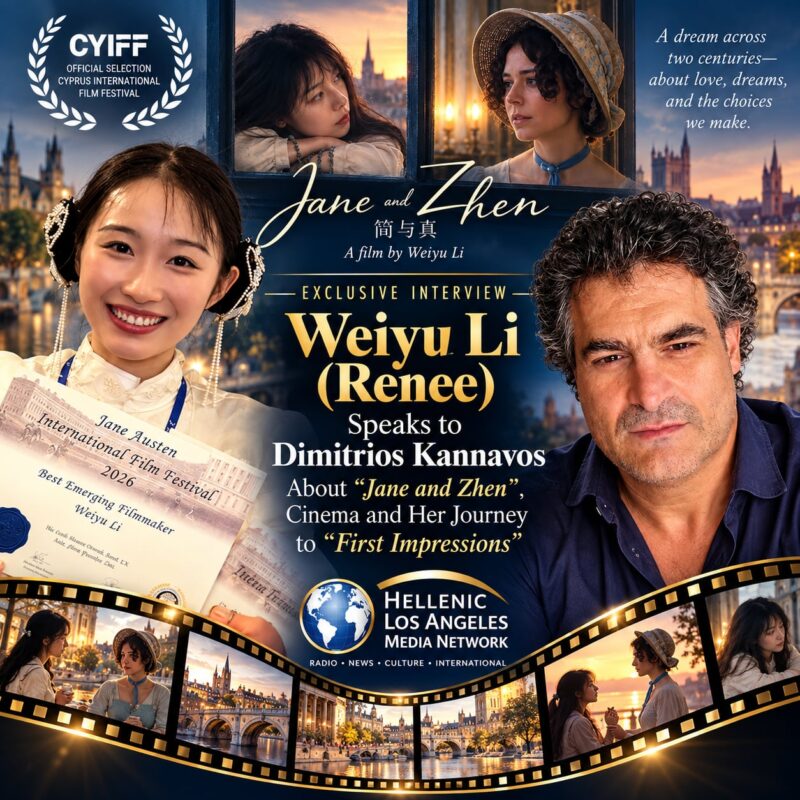
Dimitrios Kannavos: Congratulations on receiving the Best Proof of Concept for a Feature Film Award at the Cyprus International Film Festival. What does this recognition mean to you personally and professionally?
Weiyu Li (Renee) : It was a very encouraging recognition for me, especially because Jane and Zhen was originally conceived as a longer story. Its first title was First Impressions, and from the beginning, I felt there was much more to the story than I could tell in a short film.
At the same time, I didn’t know whether the story would resonate with audiences, and realistically, I didn’t yet have the resources or experience to make it as a feature. So I decided to begin with a short film.
That is why receiving the Best Proof of Concept for a Feature Film Award meant something very specific to me. I never expected the recognition to speak so directly to the film’s potential to become something longer. It felt like a very meaningful encouragement to keep exploring the story.
Dimitrios Kannavos: Could you tell us about “Jane and Zhen” and what inspired you to create this story?
Weiyu Li (Renee) : I made Jane and Zhen because I had questions I couldn’t answer.
I was thinking a lot about love and choice: Why can two people love each other and still not be able to stay together? If we choose to let someone go, does that mean the love has ended? And how much choice do we really have in love and in life?
I didn’t want to make a film that simply answered those questions. Instead, I imagined a young Chinese woman, Zhen, carrying them with her into a dream, where she meets Jane Austen in Bath — not the literary icon we know today, but Jane at the age of twenty-five.
What interested me was that this Jane might not have the answers either. They are two young women separated by more than two hundred years, meeting at moments in their lives when neither of them knows what comes next. Jane and Zhen grew from that imagined encounter.
Dimitrios Kannavos: What was the central idea or message you wanted audiences to take away from “Jane and Zhen”?
Weiyu Li (Renee) : I never really thought about what I wanted the audience to take away from the film. In a way, I was hoping to receive something from them.
The film asks questions about love, creation and eternity, but I don’t think it gives definitive answers. What interested me was what different people might find in it.
And that has actually been one of the most rewarding parts of showing the film. A filmmaker in Madrid wrote about seeing eternal love in it, and it made him think about the literary figure he had admired in his own life. Some audience members told me they simply found the film beautiful and fell in love with Bath. Others remembered someone they had loved when they were young. One filmmaker saw Zhuang Zhou Dreams of a Butterfly in it.
I love that these responses are so different. Perhaps I didn’t make the film to give the audience one thing to take away. I made it with questions, and the audience has been giving something back to me.
Dimitrios Kannavos: How did your creative journey develop from the initial idea to the completed short film and its presentation at an international festival?
Weiyu Li (Renee) : The journey really began in Bath. Jane Austen has always been one of my literary idols, and towards the end of my studies, I was going through a period of uncertainty in my own life. I went to Bath and realised that it was the year of the 250th anniversary of Jane Austen’s birth. Walking along streets she had once walked, I had a strange feeling that I should meet her there, at that particular moment.
When I later tried to persuade my team to make the film as our graduation project, I told them that we were about to graduate in the UK, so we should make something that could only exist here, at this particular time.
We were a Chinese team in Britain, in the year of Jane Austen’s 250th anniversary. Why not make a story in which a young Chinese woman meets a twenty-five-year-old Jane Austen in a dream? That idea brought the team together around the film.
The film then began to grow through the people I met. I became friends with someone involved in providing costumes for the Jane Austen Centre, who taught me a great deal about Regency clothing and helped us with period costumes and props.
Later, I met Isabelle Dickey, the actress who would become my Jane. In the first photograph I saw of her, she was wearing black performance clothes, lying on the floor and laughing. She looked nothing like the conventional image of Jane Austen, but I knew immediately: that is my Jane.
After the film was completed, another journey began through international film festivals. It has travelled to different countries and met audiences from different cultural backgrounds, and I have been fascinated by how differently people respond to it.
Receiving the Best Proof of Concept for a Feature Film Award in Cyprus has become a particularly meaningful moment in that journey, especially because the story was originally conceived as something larger than a short film.
Dimitrios Kannavos: What were some of the greatest challenges you faced while making “Jane and Zhen”, and how did you overcome them?
Weiyu Li (Renee) : One of the biggest challenges was time. We had only three days to shoot the film, with many different locations within Bath. Moving the cast, crew and equipment from one location to another through the city took much longer than I had expected.
After the first day, we realised that the pace simply wasn’t going to work. So for the second and third days, we planned the shooting schedule much more precisely and tried to make every move between locations as efficient as possible.
Even then, by the third day we were still running out of time, and I had to make some difficult decisions and cut several shots I had originally planned.
“When you realise you cannot keep everything you imagined, you have to know what is essential to the film — and protect that first.”
Dimitrios Kannavos: Your film brings together elements of different cultural perspectives. How important is cultural diversity and international storytelling in your work?
Weiyu Li (Renee) :I never consciously decided that I wanted to make a cross-cultural film. I was already standing in a cross-cultural position, so perhaps it would have been impossible for me to make a film that wasn’t cross-cultural.
At the same time, I think there are certain fundamental questions — about love, loss, choice, time — where human emotions can meet across cultures.
When I write a story, my first question is not whether it can travel internationally. I ask whether it can move me. Whether it can move other people, and whether it can cross cultures, is something I can only begin to discover afterwards.
With Jane and Zhen, that discovery began during the making of the film. I first shared the script with the Chinese members of my team, and they found something in it that moved them. Then I showed it to an older British friend who was helping us with the period costumes, and she connected with it too.
Once the film was finished, I became curious to see how this quite literary and culturally specific film would travel in very different places. So I submitted it to festivals across a wide range of cultural contexts — including the UK, the US, South Korea, Türkiye, Greece and countries in Africa.
For me, that is what international storytelling has come to mean: beginning with something I genuinely feel, and then allowing the film to travel and discovering where, and with whom, it finds a connection.
Dimitrios Kannavos: How did your experience at the Cyprus International Film Festival influence your perspective as a filmmaker?
Weiyu Li (Renee) : What stayed with me most was actually Cyprus itself. I came to Cyprus because of a film festival, but while I was there, I began to think about Cyprus itself as a place for filmmaking.
I visited museums and small galleries, and became fascinated by how much history, art and how many stories seem to exist within such a small place.
The festival also brought people into my life whom I would probably never have met otherwise. I met filmmakers from very different places and backgrounds, and some of them have become friends.
“I went to Cyprus to show a film, and left thinking that Cyprus itself was somewhere I would genuinely like to make a film one day.”
Dimitrios Kannavos: Do you see “Jane and Zhen” developing into a full-length feature film, and what would you like to explore further in the story?
Weiyu Li (Renee) : Yes. In fact, the story was originally conceived as a feature film, under the title First Impressions, and I still hope to develop it in that direction.
One of the things I would most like to explore is a more cinematic way of telling the story. The short film relies quite heavily on dialogue, partly because so much had to be compressed into fifteen minutes.
But dialogue is a literary tool. Cinema can tell stories through light and shadow, sound, movement, space and time. With a feature, I would like to give the story more room to breathe through those elements.
So for me, developing Jane and Zhen into First Impressions would not simply mean making the same story longer. It would mean finding a fuller cinematic form for the story that was there from the beginning.
Dimitrios Kannavos: As a filmmaker working in an increasingly international industry, what opportunities and challenges do you see for emerging filmmakers today?
Weiyu Li (Renee) :I think one of the greatest opportunities is that a film can now travel much further than the filmmaker’s own immediate world.
When we finished Jane and Zhen, I didn’t have a large international network. But the film began travelling to festivals, and through it I met filmmakers, producers and audiences whom I would probably never have encountered otherwise.
Sometimes your work can enter a room before you do. A small film can begin conversations, create friendships and open possibilities for future collaborations across countries.
But I have also discovered something very practical this year: a film can travel more easily than the filmmaker can.
Attending international festivals takes both time and money, and sometimes several opportunities happen at the same time. For an emerging filmmaker, these are real decisions.
Perhaps that is also part of working internationally: not only finding opportunities for your work to travel, but deciding when and where you need to travel with it.
Dimitrios Kannavos: What are your plans for the future, and is there a particular story or film project you are currently dreaming of bringing to audiences around the world?
Weiyu Li (Renee) : My current dream project is First Impressions, the feature film that Jane and Zhen originally grew from. I hope to develop it into a fantasy feature that can balance artistic expression with the possibilities of a wider theatrical audience.
I would love to direct a film for the cinema one day, so this project is very close to that dream. But I know that getting there will take time.
I want to give myself the space to develop the screenplay properly, while also beginning to look for the right investment and collaborators to make it possible.
I also want to remain open to feedback throughout that process. If I want the film to reach a wider audience and succeed commercially, I don’t think I can develop it entirely in isolation.
So my hope is not simply to make First Impressions longer or bigger. I would like to see whether it can become a fantasy film that is both personally meaningful to me and genuinely engaging to an audience — and, hopefully, the film that allows me to realise my dream of directing for the big screen.