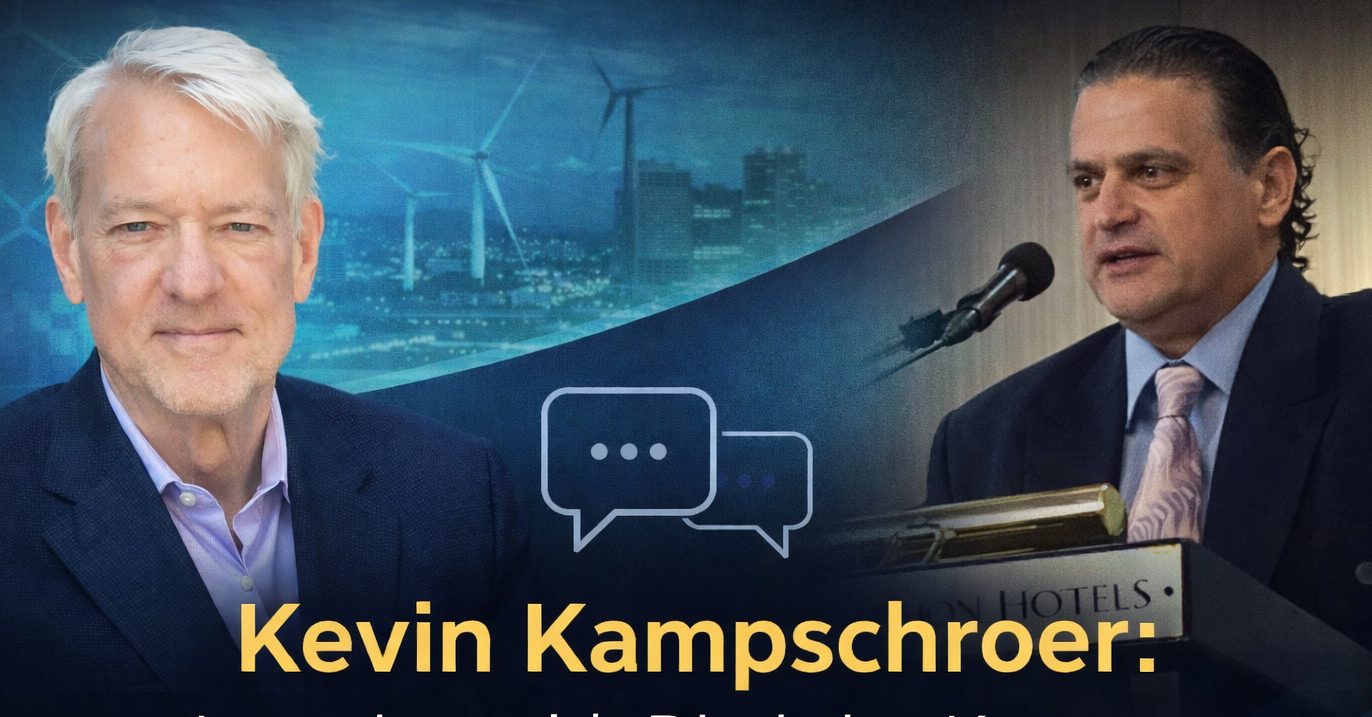
In the context of international discussions on the energy transition, sustainable development, and emerging technologies shaping the future of the global economy, Hellenic Media Group and the Hellenic Los Angeles Media Network host an important interview with Kevin Kampschroer, one of the most experienced experts in sustainability and energy policy in the United States.
With many years of experience in designing and implementing strategies for green infrastructure, energy-efficient buildings, and the promotion of clean energy, Kevin Kampschroer has played a significant role in initiatives aimed at reducing carbon emissions and advancing the transition toward a sustainable energy model.
In the interview that follows, he discusses the major challenges of the global energy transition, the technological innovations that can accelerate green development, and the role of governments, cities, and international organizations in addressing climate change.
The conversation was conducted with international journalist Dimitrios Kannavos, founder of the Hellenic Los Angeles Media Network and correspondent for Hellenic Media Group, as part of international media coverage on issues related to energy, the environment, and sustainable development.
Dimitrios Kannavos – Mr. Kampschroer, you have spent many years working on sustainability and clean energy within the U.S. federal government. What do you see as the most critical global challenge in the transition to clean energy today?
Kevin Kampschroer- The most difficult challenge is the widespread retrenchment of the commitment to increasing multiple sources of clean energy to grids, most particularly in the US and Europe. The antagonism toward wind energy in the US is difficult to understand. The slackening of the adoption of EVs due to evaporating government tax benefits while the tax benefits for oil-based energy sources stay firmly in place will reduce the ability of vehicle manufacturers to scale up, and thus make EV prices more competitive.
Dimitrios Kannavos – Mr. Kampschroer, you have spent many years working on sustainability and clean energy within the U.S. federal government. What do you see as the most critical global challenge in the transition to clean energy today?
Kevin Kampschroer- The most difficult challenge is the widespread retrenchment of the commitment to increasing multiple sources of clean energy to grids, most particularly in the US and Europe. The antagonism toward wind energy in the US is difficult to understand. The slackening of the adoption of EVs due to evaporating government tax benefits while the tax benefits for oil-based energy sources stay firmly in place will reduce the ability of vehicle manufacturers to scale up, and thus make EV prices more competitive.
Dimitrios Kannavos – From your perspective, how can governments accelerate the transformation of public infrastructure toward net-zero emissions?
Kevin Kampschroer- First: lead by example in all government operations, particularly buildings and transportation. Make sure that buildings are safe, healthy and energy efficient, preferably all electric. Maximize electric busses in particular.
Second: devote public resources to modernizing grid infrastructure, whether through regulation, or direct investment, or incentives for private investment.
Third: establish or restore incentives for EV use.
Fourth: Level the regulatory and tax framework for energy sources (e.g., in the US, eliminate the oil depletion allowance). Adjust for unpriced externalities, such as the medical costs of dirty air, the pollution of water supplies from polluted runoff (e.g., mining, manufacturing, others.)
Dimitrios Kannavos – You have worked extensively on sustainable federal buildings. How important is the role of architecture and urban design in addressing climate change?
Kevin Kampschroer- In the US, buildings account for 40% of GHG emissions, with over 30% from energy consumption. Worldwide, it is about the same. Buildings need to be designed and renovated in a way that radically reduces GHG emissions, both from embodied carbon and from operations. The confluence of architectural and urban design can mitigate transportation impacts. Most importantly, re-use of existing buildings can be challenging, and should inspire architects and engineers to design with the constraints of re-use.
Dimitrios Kannavos – What lessons from U.S. federal sustainability programs could be useful for European countries and developing economies?
Kevin Kampschroer- The most useful contribution from federal sustainability programs was to demonstrate, and prove, the effectiveness of various energy efficiency programs, building standards, and operational practices. Because the government is generally not as concerned about secrecy as private entities, making the success (or failure) of projects public can inform the rest of the economy. After-completion project review and on-going measurement mad public are powerful tools to encourage improvements and to bolster understanding about the impacts of technologies, design decisions, construction techniques, and operational choices.
Dimitrios Kannavos – Energy transition requires cooperation between governments, industry, and science. What model of collaboration works best in practice?
Kevin Kampschroer- On a project-scale, integrated design, construction, and operation makes the most sense, and inevitably results in lower capital costs, lower operations, and better overall buildings as a result.
More broadly, there is still a critical gap between invention, testing and proof of concept, and commercialization. Governments’ role should be to set the broad policy direction, and fill the gaps to commercialization, either through direct investment, testing and publicizing results, or creating incentives to adoption of new proven technologies. Many Universities now have developed ways to support commercialization of scientific research; they are good models.
Dimitrios Kannavos – How do you evaluate the current progress of the global clean energy transition? Are we moving fast enough?
Kevin Kampschroer- Simply put: No, emphatically not.
Dimitrios Kannavos – What technological innovations do you believe will most transform the energy sector over the next decade?
Kevin Kampschroer- Multiple storage solutions linked to a more dispersed set of energy sources, connected by two-way grids.
Dimitrios Kannavos – Climate change policies often face political and economic resistance. How can leaders balance economic growth with environmental responsibility?
Kevin Kampschroer- Governments should be able to look to the long term better than private, commercial enterprises. Economic growth in the future is not going to follow the paths of the past. One blatant example is the investment in AI. Governments should be more willing to encourage creativity in these massive investments, rather than just allowing status-quo practice. The creation of massive data centers using 20th century cooling technology is a huge lost opportunity. Given the massive cost of these centers, creative, energy efficient solutions are easily in reach, and would not add overall expense, even if initial capital expense might be a little higher.
Dimitrios Kannavos – How important are public-private partnerships in accelerating large-scale sustainability projects?
Kevin Kampschroer- They are essential..
Dimitrios Kannavos – Cities are responsible for a significant share of global emissions. What role should metropolitan areas play in the fight against climate change?
Kevin Kampschroer- They need to capitalize on the value of the density of infrastructure and population. There are opportunities for sharing resources both on a neighborhood scale and on metropolitan-wide infrastructure. High quality and densely deployed public transportation is one obvious example. The US is a laggard in this arena, and not just because the population is spread out. Cities have the ability to concentrate on existing infrastructure in a way that can be very impactful. District heating systems, thoughtfully designed microgrids, shared services are a few examples.
Dimitrios Kannavos – Many countries are investing heavily in green infrastructure. What are the biggest mistakes governments should avoid when implementing such programs?
Kevin Kampschroer- Dictating practices rather than outcomes might be a good catch-all. Some things, like electrical grids, need centralized management, and governments might need to be more directive to overcome entrenched economic biases. I think governments should be less afraid of failures: progress is rarely achieved without some failures along the way. Of course, failure gets more publicity, which takes some political will to accept.
Dimitrios Kannavos – How can international forums and symposiums help create real progress in global sustainability policy?
Kevin Kampschroer- The exchange of knowledge and ideas is essential for progress. Sharing what worked (and what didn’t) can improve policies in other areas and countries. Even though economies, cultures, and politics vary, discussing how different ideas work in different context inspires connections, insight, and progress. This is why I am particularly happy to be returning to WGES in Athens this year. It was in the first WGES forum in Philadelphia that I walked away with numerous ideas which we then incorporated into the work that we were doing in sustainability in buildings for the U.S. General Services Administration throughout the United States. The combination of design professionals, engineering, expertise, and policy formulation was an exciting blend of people and ideas. As we progressed and gained more experience in different techniques, operational practices, and equipment, we were happy to return to WGES and share our experience with other others. Every conference gave me as many new ideas as I might have brought to others. I continue to look forward to sharing what I’ve learned in 50 years of work.
Dimitrios Kannavos – From your experience, what are the key indicators that a sustainability strategy is truly effective and not just symbolic?
Kevin Kampschroer- Rigorous reporting, using common frameworks. In the building arena, LEED, WELL, ASHRAE (ICC) have well developed standards. Using common standards for life cycle assessment is important. Third-party auditing is an important component.
Dimitrios Kannavos – Looking ahead to the next 20 years, how do you envision the global energy landscape evolving?
Kevin Kampschroer- Solar, wind, and geothermal (ground-source or direct) will continue to expand; their costs are coming down, and other sources continue to rely on subsidies for survival. China will continue to drive expansion and innovation with its massive economy, and equally massive need for expanding their energy supply. Grid infrastructure will more slowly improve, coupled with scale and technology breakthroughs in storage solutions. Transportation will become massively more EV dominated, and infrastructure will expand to meet the current gap.
Dimitrios Kannavos – Finally, what message would you like to share with young scientists, engineers, and policymakers who want to contribute to the global sustainability movement?
Kevin Kampschroer- First: it is a great field, with immense potential for growth, personal, organizational, scientific, and political.
Second: I think the dividing line among disciplines—such as architecture, engineering, and construction—will continue to blur, and we put more widely into practice what we already know, that teams make better decisions, designs, and science than individuals. The value of people who know more than one field has never been higher.
Third: We are in this field because we want to make a positive difference for us, for our families, our communities, and ultimately the world. Being a part of making improving life could not be more rewarding.
ΠΗΓΕΣ HELLENIC LOS ANGELES MEDIA NETWORK HELLENIC MEDIA GROUP